
You’ve spent a month diligently reading your next book club pick. Once everyone is gathered in a cozy living room, wine or something good to eat in their hands, you settle in to start the conversation. But…what are the best book club questions?
I know a common way to begin is to ask, “So, did everyone like the book?”
And sometimes that simple question is all it takes to get everyone sharing thoughtfully. However, more often than not you might get a few polite answers and then the conversation wanders away from the book. Or, what’s happened in my case a time or two, everyone chimes in that they loved the book, but I feel the total opposite. So, I sit quietly for the remainder of the discussion because I start wondering if I’m the only person who somehow missed something while I was reading!
That’s also why I’ve become hesitant to begin a discussion by asking whether everyone liked the book. When we lead with our opinions, it’s easy to start evaluating the story before we’ve really taken the time to understand what the author is doing. And once a few strong opinions are shared, other readers may be less willing to offer a different perspective.
I would rather begin with curiosity. What did we notice? Why might the author have made that choice? What does it help us understand?
A good book club discussion doesn’t require dozens of perfectly crafted questions specific to each book. In fact, some of the best book club questions can be used again and again, no matter what your group is reading.
I believe the key is asking questions that help readers move beyond what happened in the story and start thinking about why it matters, or what it means to me as a reader, a mother, a wife.
After a decade of teaching students to talk thoughtfully about books, as well as plenty of experience discussing books with adults too, I’ve found that the best conversations tend to follow a natural progression.
First, we share about what we notice in the book, then we interpret how it helps to shape the story, and then we make connections. That helps us to talk about the bigger ideas the book is inviting us to consider.
This type of conversation is what I help women create as they work through the Discussion Framework I created for book clubs.

What Makes a Good Book Club Question?
I have found that the best book club discussion questions work to do a few important things at once. The first one is that they don’t have one correct answer.
Instead of asking everyone to recall a specific fact from the story, encourage them to share their own observation or interpretation instead. For example:
Less helpful:
What happened when the main character arrived in London?
More helpful:
How did the change in setting affect the character?
The first question determines whether everyone remembers the book, but the second question will give the readers more to talk about. In fact, you might find that people have different responses to this answer, which is exactly what you’re looking for.
Another important distinction to a thoughtful discussion: it doesn’t need to begin with the deepest possible question. If you jump straight to determining what the author’s main themes are in the story, it can cause the conversation to feel heavy.
If, instead, you begin with questions that are easy for everyone to answer and then gradually move toward interpretation and reflection, it will help to bring more people into the conversation more naturally.
Start With What Everyone Noticed
One of the simplest ways to begin a book club discussion is to ask people what caught their attention.
You might ask: What moment, character, quote, or idea has stayed with you since you finished the book?
With this type of question, there isn’t a wrong answer because one person may have connected with a particular character, someone else may have been confused by the ending, and another person might have underlined a sentence that everyone else barely noticed.
The beauty of this is that your conversation can take on a life of its own. This is one reason I don’t think a book club leader needs to arrive with 40 questions printed from the internet. It’s likely, you won’t use most of them anyway.
A few well-chosen questions, and a willingness to follow the conversation where it naturally leads, often result in a much better discussion.
Related: Book Club Discussion Guide if you’d like more help structuring the conversation itself.

Talk About the Characters’ Choices
Characters give us one of the easiest entry points into meaningful conversation. I have found that my own book club often spends the largest part of our discussion talking about the characters, even in plot-driven stories.
Instead of simply asking whether everyone liked a character, try something such as: Which character’s choices did you understand most? Which were hardest for you to understand?
Now you’re asking readers to interpret motivation rather than immediately pass judgment on the character.
I think there is something important about learning to receive a story before we evaluate it. C. S. Lewis wrote about the danger of approaching a work of art primarily through our own judgments in An Experiment in Criticism. He asked first whether we approve of it, agree with it, or like it—rather than allowing the work to show us what it is trying to say.
The same can happen in book club. If we begin with “I hated her” or “He was awful,” we may close ourselves off from asking more interesting questions: Why did this character make that choice? What did the author want us to notice? What does this reveal about human nature?
Strong opinions can also shape the room more than we realize. If one person quickly declares that a character, or even the whole book, was terrible, someone who saw it differently may become less willing to share. Curiosity leaves more room at the table.
We don’t have to suspend judgment forever. But when we begin by trying to understand before deciding what we think, we give both the author and the other readers in the room a better hearing.
Two people can read exactly the same scene and come away with very different explanations for why a character behaved the way they did. And that’s when a discussion becomes interesting.
You can also ask:
- What did a character want most?
- What seemed to be driving his or her decisions?
- When did you begin to understand this character differently?
- What do you think the character misunderstood about himself, another person, or his circumstances?
- What consequences followed from the choices the character made?
And don’t be afraid of disagreement. Some of my favorite book club conversations happen when two readers see a character completely differently.
Pay Attention to the Author’s Choices
A good book club discussion also considers how the story was told. With this type of question, you want to think about the setting, point of view, structure, symbolism, repetition, or even something the author deliberately chose not to tell you.
A question as simple as: Why do you think the author chose to tell the story this way? can take you in all sorts of interesting directions.
I have found that this works particularly well with books that use an unusual (or an unreliable) narrator, move backward and forward in time, contain multiple perspectives, or leave certain questions unanswered.
And you don’t need an English degree to talk about any of it. You’re simply paying attention to the choices the writer made and considering their effect on the reader.
Look for the Bigger Ideas
This is where book club discussion questions can begin moving beyond plot.
Ask: What ideas or themes kept appearing throughout the book?
Maybe your group notices ideas about friendship, ambition, beauty, grief, family, justice, home, sacrifice, loneliness, courage, or forgiveness.
Make a note of that, then keep going. You might then ask: What did the book seem to suggest about that idea? Did you agree?
These responses are often what people remember long after they’ve forgotten smaller details of the story. I’ve also found that this part of the conversation can cause someone to rethink whether or not they enjoyed the book or not. (It happened to me after reading The Buried Giant by Kazuo Ishiguro!)
And, of course, choosing a book that gives you something substantial to wrestle with makes this easier.
Related: link to What Makes a Book Worth Discussing?
Make Room for Personal Connection
One of the things I love most about discussing literature is that the stories have enough depth to lead to something beyond what’s just on the pages. These stories often point to our own stories, which is beautiful when we get to learn more about one another; we get to hear the stories of those in our community.
It doesn’t feel forced, but it happens naturally. We might see a picture of someone that reminds us of ourselves or a family member. Or, a book set in another time or place may help us see our own culture differently.
So one of my favorite kinds of book club questions is: Did this book change the way you think about anything?
Sometimes the answer is no, but there are also times that one question opens an entirely new conversation.
A Simple Framework Makes Leading Much Easier
The purpose of discussion questions is to help serve the conversation. If one question leads to twenty minutes of thoughtful discussion, then stay there. Enjoy it. If another question falls completely flat, it’s okay to move on. Or maybe consider asking the question in a different way.
The goal of a successful book club meeting is to create connection through your conversation.
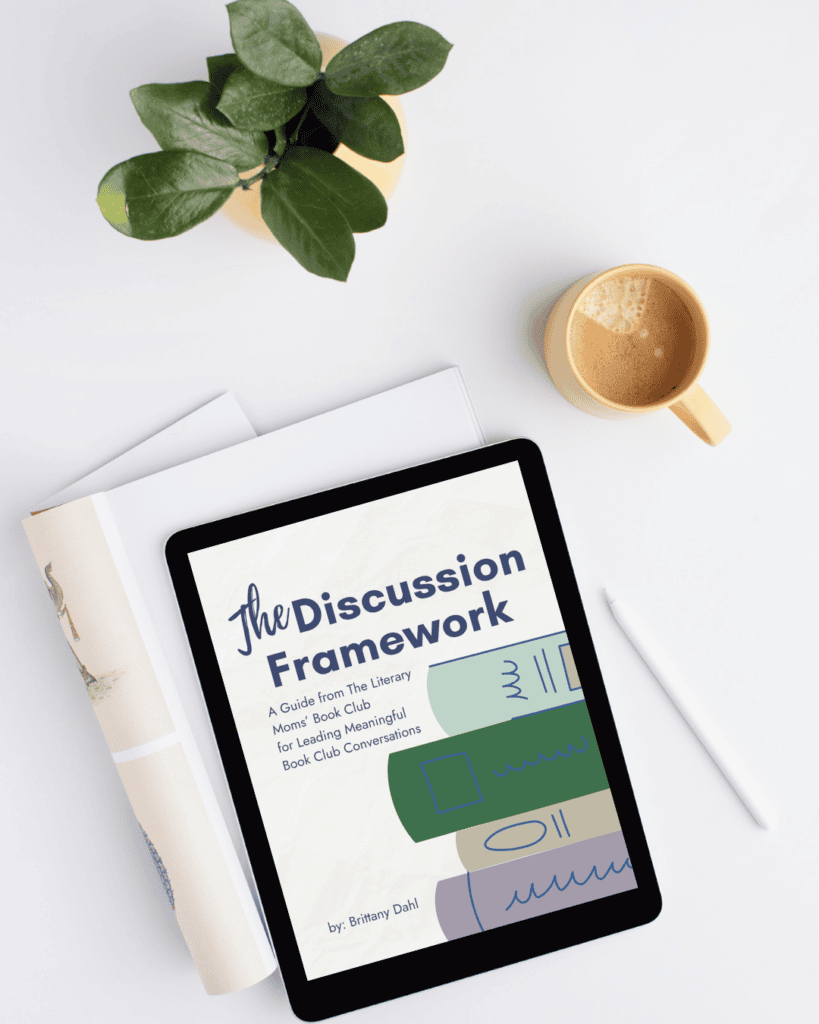
And this is exactly why I created my Discussion Framework.
Instead of searching Pinterest or Google for a brand-new list of questions every month, you can use the same thoughtfully designed structure with almost any book.
The Framework includes 11 questions that move your group from simple observations into deeper conversation, along with practical guidance for leading the discussion.
You don’t have to be an expert on the book or prepare a mini lecture And you certainly don’t need to have all the answers. You just need a good place to begin.
Ready to Make Your Next Book Club Discussion Easier?
My printable Discussion Framework gives you the 11 questions I use to help readers move from talking about what happened in a book to discussing what it means.
You’ll also get guidance to help you lead the conversation with more confidence—without spending hours preparing beforehand.
What If You’re Starting a Book Club From Scratch?
If you’re reading this because you’ve been thinking about starting a book club but haven’t actually gathered everyone together yet, start here instead.
Maybe you love the idea of meaningful conversations about great books…but you don’t particularly want another thing to organize. That’s part of why I created The Literary Moms’ Book Club. Plus, you get The Discussion Framework for free inside!
Inside the membership, I choose books worth reading and give members a simple reading plan and ongoing discussion support. Women can participate online, or use the resources to gather their own local group and discuss the books together.
It’s designed to make it easier to build a regular reading life, and meaningful conversations around those books, without having to start from scratch each month.
Learn more about The Literary Moms’ Book Club

Good Book Club Questions Are an Invitation
You don’t need to lead the perfect conversation, and you don’t need to understand every symbol, theme, or literary technique hiding inside a book. The point of gathering together is to notice things you might have missed on your own.
Someone else will see the character differently or notice a theme you overlooked. And someone else’s story will change the way you think about a scene. That’s exactly what makes discussing books together so worthwhile.
So the next time everyone gathers around the table and you find yourself wondering what to ask first, don’t worry about finding the perfect question.
Start with one good question. Then listen because the conversation may surprise you.